Notes to Management
Recommendations to Improve ADB as an Organization
The issue of inequitably distributed workload and its related stresses are not new for our office. In the past few years, we have received a consistent number of associated issues and concerns.
Some individuals who approached our office shared increasing instances of interpersonal conflicts because of perceptions of inequitable workload distribution, stresses of looming deadlines, and nervousness regarding recent organizational challenges.
Others shared how the protracted period of disruptions and continuous adjustments since the pandemic, combined with increasing workloads, took a toll on their mental, physical, and emotional health. These trends piqued our interest in understanding the relationship between workload, stress, and the escalating instances of burnout we have been observing.
The Interconnectedness of Workload, Stress, and Burnout
(Hover on the boxes to see more information.)
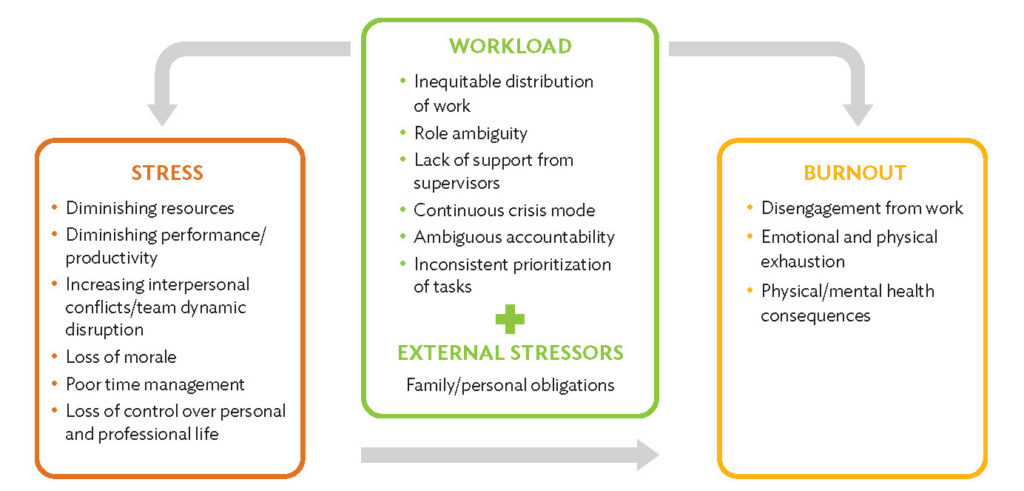
STRESS
- Diminishing resources
- Diminishing performance/productivity
- Increasing interpersonal conflicts/team dynamic disruption
- Loss of morale
- Poor time management
- Loss of control over personal and professional life
WORKLOAD + EXTERNAL STRESSORS
- Inequitable distribution of work
- Role ambiguity
- Lack of support from supervisors
- Continuous crisis mode
- Ambiguous accountability
- Inconsistent prioritization of tasks
EXTERNAL STRESSORS
Family/personal obligations
BURNOUT
- Disengagement from work
- Emotional and physical exhaustion
- Physical/mental health consequences
A Comment on Organizational Culture
In all honesty, the OOMP team initially questioned whether these trends merited being raised as significant concerns in a “Note to Management.” We realized our hesitation stemmed from the fact that the existing organizational culture at ADB may involuntarily undermine the issue of workload.
Read more
In our experience, whenever a member of our team asked individuals at ADB how they are, the usual response has often been that they are very busy or have a lot on their plates. While this may be factual in many instances, it has become the standard acceptable response. Over time, we began to get the sense that, at times, staff who gave such responses must have internalized the belief that they should be feeling overwhelmed or managing excessively heavy and seemingly unsustainable workloads to be considered truly productive or competent.
No matter the output, “busyness” is regarded as a virtue or a status symbol.
With time, this attitude becomes embedded into workplace culture; thus, continuous pushes against deadlines, workload mismanagement, and/or unequitable workloads become the norm.
Insights from our confidential conversations regarding interpersonal conflicts within teams also shed light on this perception: some individuals feel pressured by the need to keep up with the status quo, and so they try to assert their competence by appearing busy. In cases where these individuals are struggling with meeting productivity demands, their responsibilities may be shifted to others on the team. Consequently, this inadvertently triggers conflicts.
These interpersonal conflicts, in turn, create ripple effects in the form of reduced collaboration, creativity, and innovation. These effects, among others, can detract from associating “workload” as the real issue.
The fact that organizational cultures generally do not always prioritize wellness is an important cause for concern.
Stress, in general, has unfortunately ingrained itself into both our daily lives and work environment. Toxic workplace behaviors brought on by these workload imbalances and interpersonal conflicts within teams make matters worse and are the drivers of negative organizational outcomes, such as burnout and intent to leave.
It can be difficult to recognize that it is, in fact, the organizational culture that is at the root of these problems. According to a global survey by McKinsey Health Institute, organizations around the world are facing persistent burnout challenges. Rising levels of burnout are a strong indicator that the organization as a whole (and not just the individuals inside it) needs to go through a significant systemic change. ADB is not exempt from this trend.
Workload
The significance of workload in relation to job burnout and stress has been highlighted in numerous research studies. In addition, the number of working hours has been proven to be adversely associated with emotional exhaustion. Administrative workload is particularly identified as a strong predictor of burnout.
Workload is recognized as both physical and mental. It is a complex concept that has disproportionate effects on individuals. It refers to the feeling of being overwhelmed with a large or uneven volume of work that surpasses an individual’s capacity at a given time.
Work-Related Stress
The characteristics of work-related stress, which is defined as stress that has been caused or made worse by workload pressures, are similar to those of general stress; hence, its effects and consequences can be assessed in the same manner.
Time pressures, multitasking, and heavy workloads can frequently result in stress, burnout, and reduced levels of organizational commitment. Excessive stress affects everyone differently. When workload demands exceed an individual’s ability to cope, some may experience stress more severely than others, leading them to fall ill and requiring time off from work.
A Brief Note on External Stressors or Work–Family Conflict
We cannot take a holistic view of an individual at the workplace without considering their external stresses. Our pandemic experiences, as well as observations since the adoption of hybrid work in 2022, made it clearer that there can be a two-way conflict between work and family: work can interfere with family time and obligations, in the same manner that family obligations can interfere with work.
In addition, although work–family conflict can sometimes be perceived as primarily a woman’s issue, changing notions of parenthood demand that men share increased or equivalent familial responsibilities, potentially increasing the likelihood that both men and women experience greater work–family conflict.
Burnout
The World Health Organization defines burnout as “an occupational phenomenon (…) resulting from chronic workplace stress that has not been successfully managed” and can have significant physiological and psychological consequences.
Read more
Burnout is not caused by a single stressful event but rather by a series of related factors. Although the effects of burnout are felt by individuals, they do not occur in a vacuum. Burnout can have negative consequences for both the team and the workplace. Absenteeism, decreased performance, interpersonal conflict, low motivation, and ultimately, turnover, are just some of the detrimental effects of burnout. High levels of stress and low self-esteem are two additional unfavorable health effects that are linked to burnout.
Although the effects of burnout are felt by individuals, they do not occur in a vacuum. Burnout can have negative consequences for both the team and the workplace. Absenteeism, decreased performance, interpersonal conflict, low motivation, and ultimately, turnover, are just some of the detrimental effects of burnout. High levels of stress and low self-esteem are two additional unfavorable health effects that are linked to burnout.
Reimagining Workload
We can no longer ignore how the workplace affects employee performance, well–being, and engagement. The New Operating Model is an opportunity to reimagine how we work and what we do. ADB must seize this opportunity of change to also address our organizational culture. We suggest the following:
Recognize that burnout is a systemic issue.
Heavy workload and mismanagement of workload impact employee well–being. It is therefore important to demonstrate support for mental well–being and legitimize burnout as an occupational phenomenon and systemic issue. Ensure that resources are allocated to best serve the needs of the ADB community.
Treat the root cause, not the symptoms.
Incorporate workload management as part of leadership training. Some managers may lack workload management skills or have not been trained to face the additional challenges brought on by our new ways of working as well as by the upcoming organizational changes. Supporting supervisors and managers may result in a reduction of negative outcomes, such as reduced interpersonal conflicts in teams. In addition, provide training for supervisors and managers to recognize and proactively inquire about the well–being needs of their team members.
Provide stress management support.
Recognize the demands on different members of the ADB community. Continue investing in, expanding, and communicating about mental health support and benefits available at ADB.
Cultivate a culture of accountability.
Hold those in positions of team leadership accountable by including metrics around staff well–being or incorporating relevant questions into 360 performance reviews. This will inculcate trust in the organization, as well as convey the message that managers and supervisors care, thereby empowering staff to share honest and productive feedback.
It is important to keep in mind that a tailored approach may need to be considered. Since a one–size–fits–all solution may not work, the approach may need to be individualized for different departments, divisions, and/or field offices.